Why Jim Keller's $10K RISC-V Box Could Break NVIDIA's AI Monopoly
Tenstorrent just shipped the first RISC-V AI workstation with a fully open-source stack. Here's why this matters more than you think.
The Box on Your Desk That Doesn’t Need NVIDIA’s Permission
Imagine you’re building an AI startup. Your first call is to a cloud provider. Your second is to buy GPU hardware. Your third is to sign a license agreement. Every layer of your stack is owned by someone else — someone who can raise prices, cut access, or change terms without asking.
Now imagine a box that plugs into your office wall, runs 120-billion-parameter language models at your desk, costs less than a data center rack, and comes with every single layer of its software stack open source for anyone to inspect, fork, and modify.
That box just shipped. And its name is TT-QuietBox 2.
What Exactly Is It?
Tenstorrent — the AI compute company founded by Jim Keller, the legendary chip architect behind AMD Zen, Apple A4/A5, and Tesla’s FSD chip — announced the TT-QuietBox 2 at GDC 2026 in March. It’s a whisper-quiet, liquid-cooled AI workstation running entirely on RISC-V architecture.
Here’s the spec sheet that made engineers do a double-take:
- Four Blackhole ASICs working as a unified mesh inside a single desk enclosure
- 480 Tensix cores delivering 2,654 TFLOPS at BlockFP8 precision
- 128 GB GDDR6 + 256 GB DDR5 system memory
- Runs GPT-OSS 120B entirely on-device
- Llama 3.1 70B at 476.5 tokens per second
- Predicts a 686-amino-acid protein in 49 seconds (a CPU takes 45 minutes)
- Ships at $9,999
- Runs on a standard 120V wall outlet — no server room, no special electrical work
That last point is the part nobody talks about enough. This is a teraflop-class AI inference system that you can plug into a regular outlet and put on your desk. Not a rack. Not a data center. Your desk.
Why RISC-V Changes Everything
Let’s be clear: Tenstorrent being RISC-V is not a quirky architectural choice. It’s the entire point.
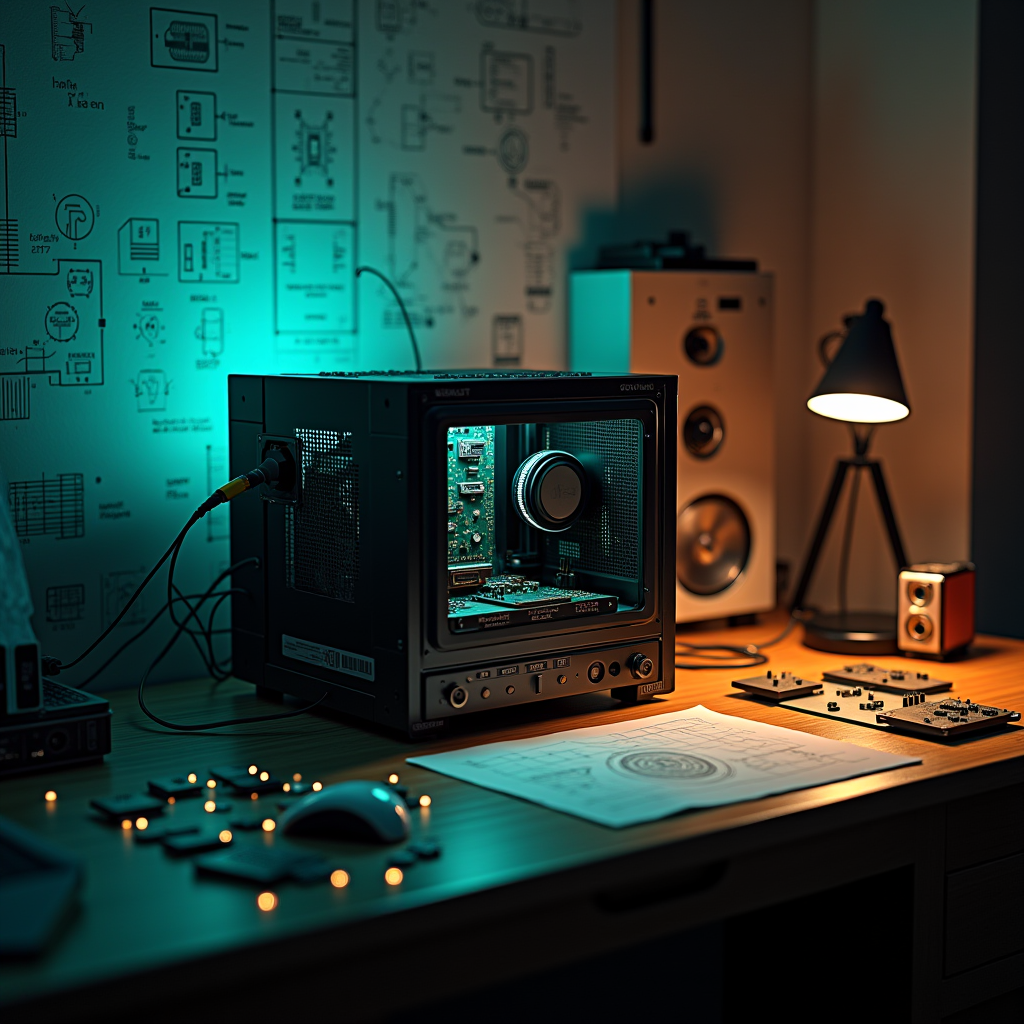
RISC-V is an open-source instruction set architecture — anyone can design chips that speak its language without paying licensing fees to ARM or Intel. For AI hardware, this means something radical: no single company controls the roadmap.
Most AI accelerators today are NVIDIA. You buy their GPUs, you use their CUDA software, you live in their ecosystem. If CUDA becomes more expensive, you’re stuck. If NVIDIA decides to deprioritize a use case, you deprioritize it too. That’s not a market — that’s a monopoly.
RISC-V breaks that lock-in at the silicon level. Tenstorrent builds its Tensix cores in RISC-V. They build their compilers (TT-Forge), their low-level SDK (TT-Metalium), their kernel software (TT-LLK), and their development studio (TT-Studio) all on open-source licenses. Every layer.
As Keller put it in the announcement: “Build your own software or hardware. You can own your AI future.”
That’s not marketing copy. That’s a philosophy.
The Inference Economy Is Tipping
Here’s the data point that makes this timely: inference now accounts for more than 55% of cloud AI infrastructure spending — roughly $37.5 billion annually and still growing. Training gets all the headlines, but inference is the workhorse. It’s the daily grind. It’s what runs your chatbot, your recommendation engine, your coding assistant.
And the current economics are brutal. Every token your model generates costs money. Scale up, and those costs compound. You’re essentially renting intelligence forever.
Tenstorrent’s pitch is different: buy the hardware, own the stack, run inference locally. For small and medium businesses, for research labs, for sovereign AI deployments where data can’t leave your building — this is a fundamentally different economic model.
The protein folding numbers are telling. A single Blackhole chip folds a massive protein in 49 seconds. Four in parallel give you 4x throughput. A modern CPU takes 45 minutes. That’s not a marginal improvement — that’s a category shift.
What’s Actually Running On It
The QuietBox 2 ships ready for deployment with several workloads:
Language Models: GPT-OSS 120B runs entirely on-device. Llama 3.1 70B delivers 476.5 tokens/second. Qwen3-32B deploys as a private coding agent — no cloud token limits, no data leaving your desk.
Creative Workloads: Flux handles image generation locally. Wan 2.2 does video synthesis. Your creative IP stays on your machine.
Scientific Research: Boltz-2, a biomolecular ML model, folds proteins at speeds that make CPU-based approaches look medieval.
For models not on the pre-installed list, TT-Forge — Tenstorrent’s open-source compiler — can run models from PyTorch, ONNX, TensorFlow, JAX, and PaddlePaddle directly to the hardware. If it runs on a standard framework, it runs on QuietBox 2.
The Architecture That Avoids NVIDIA’s Bottlenecks
Here’s where the silicon design gets interesting. Conventional AI accelerators (NVIDIA’s included) are limited by what’s called the “memory wall” — the bottleneck between computation and data access. Their GPUs rely on HBM (High-Bandwidth Memory), which is expensive and in chronic short supply.

Tenstorrent’s Blackhole chips integrate compute and high-density SRAM on a single die. This “dataflow” architecture moves tensors efficiently through on-chip memory, sidestepping the DRAM bottleneck entirely. They use GDDR6 and on-chip SRAM instead of HBM — which also means they’re insulated from the HBM supply shortage currently driving price increases across the AI hardware market.
Four Blackhole ASICs form a unified mesh inside the QuietBox 2, giving you the performance of a small cluster without the cluster.
What This Means for 2026
Let’s put this in perspective. It’s May 2026. RISC-V is no longer a hobbyist architecture. SiFive just shipped its P570 Gen 3 with full RVA23 profile support. Milk-V’s Jupiter2 brings a RISC-V desktop to your desk. Framework laptops now offer RISC-V mainboards. NASA is qualifying RISC-V chips for spaceflight.
And Tenstorrent has delivered the first RISC-V AI workstation capable of serious inference work.
This isn’t a “maybe someday” story. It’s a “shipped last quarter, shipping globally now” story. The quietbox ships in Q2 2026. It costs $9,999. You can join the waitlist today.
The Bigger Picture
Jim Keller built his career on taking expensive, closed, vendor-locked hardware and making it open, accessible, and actually good. AMD Zen killed Intel’s CPU monopoly. Apple’s A-series chips made ARM relevant for laptops. Tesla’s FSD chip brought autonomous driving silicon in-house instead of relying on NVIDIA.
Now, at Tenstorrent, he’s doing the same thing for AI inference hardware. RISC-V. Open-source stack. Desk-sized enclosure. A price that doesn’t require a venture capital round.
The monopoly on AI compute is cracked. Not shattered — cracked. But cracks let light in. And in 2026, light is exactly what the AI hardware market needs.

Quick Quiz
1. What instruction set architecture does the TT-QuietBox 2 use? a) ARM v9 b) RISC-V c) x86-64 d) PowerPC
Show Answer
a) ARM v9 · b) **RISC-V** · c) x86-64 · d) PowerPC · The correct answer is **b) RISC-V** — Tenstorrent builds its Tensix cores on the open-source RISC-V architecture, which eliminates licensing dependencies on ARM or Intel.2. What is the “memory wall” problem that Tenstorrent’s architecture sidesteps? a) The physical limit of how much RAM a desk can hold b) The bottleneck between compute and data access in conventional accelerators c) The speed limit of USB connections to external storage d) The thermal throttling that occurs when GPUs get too hot
Show Answer
The correct answer is **b)** — The memory wall is the bottleneck between computation and data access. Tenstorrent sidesteps it by integrating compute and SRAM on a single die, using a dataflow architecture instead of relying on external HBM.3. Why is inference more important than training for most AI companies in 2026? a) Training only happens once; inference runs every time a user interacts with the product b) Training requires less hardware than inference c) Inference models are easier to train d) Regulatory requirements only apply to inference
Show Answer
The correct answer is **a)** — Inference accounts for over 55% of cloud AI infrastructure spending ($37.5B). Training is a one-time cost; inference runs continuously every time a user generates output, making it the dominant economic driver for AI companies.Watch the short